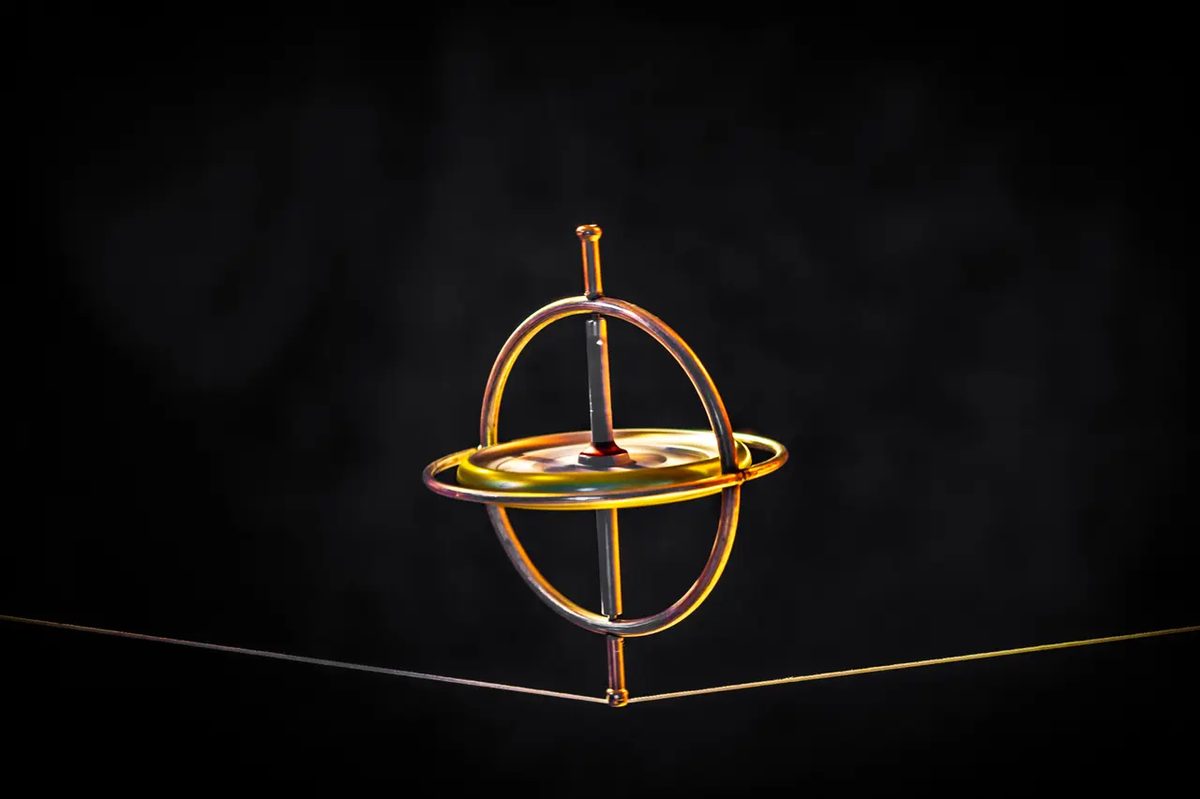
Rotate. Stays upright. It’s just physics, but it defies gravity in an almost magical way.
Gyroscopes sound like little-known historical devices until you realize they’re in smartphones, drones, and airplanes. Basically, it is a device that uses conservation of momentum to measure or maintain direction and angular velocity. This term was coined by the French physicist Léon Foucault in 1852 and is derived from the Greek words gyros (circle) and scope (observation). In other words, watch the rotation.
The cycle of history
Foucault did not invent the gyroscope out of thin air. He was obsessed with proving that the earth rotates.
In 1851, he used a heavy pendulum that was suspended from the dome of the Panthéon in Paris. The pendulum swung for hours. The room turned underneath it. This effect is direct visual evidence of the rotation of the Earth driven by the Coriolis force. But Foucault realized something else. The oscillation plane of the pendulum moves slower than the rotation of the Earth, which is determined by the sine of the latitude.
He worked with physicist Jules Lissajous and engineer Froment to fine-tune the mechanism. By limiting the movement of the pendulum, they created a device that coincided with the meridian. It points north. This was the birth of the gyrocompass.
Why is this important? Because a magnetic compass is useless near magnetic poles. It doesn’t spin too hard and doesn’t point its finger at anything. The gyrocompass finds true north regardless of where you are on the planet.
However, its roots go back even further. In 1810, German astronomer Johann Bohnenberger invented the first three-axis gyroscope. He called it a “miracle machine.” Foucault later refined this, gave it a name, and showed that a rotating rotor maintains its orientation in space, regardless of the Earth’s rotation.
By the end of the 19th century, these devices were motorized. The gyrocompass replaced magnetic compasses on metal-hulled ships that distort traditional navigational tools. By the beginning of the 20th century, the military recognized this value. Gyroscopes are essential for stabilizing vehicles, guiding torpedoes, and ultimately controlling aircraft.
How the gyroscope actually works
You’ve probably seen a gyroscope. It looks like a top.
A standard mechanical gyroscope consists of a rotating plate mounted in a series of rings called gimbals. These rings allow the disc to rotate freely in any direction.
Stability analysis
Traditional mechanical units include:
- A rotating disc in the middle
- A rotation axis passing through the disc’s center
- Internal universal joint ring supported by virtually frictionless ball bearings
- Outer frame
The center of gravity must be exactly in the center of the puck. When it’s turned off, the whole thing vibrates unnecessarily.
Angular momentum
The magic is in angular momentum (or moment of momentum). This is a vector. When an object rotates around an axis of symmetry, the angular momentum vector points along that axis.
The rules are: If an object is not acted upon by an external torque, its angular momentum remains constant. The axis stays stable. That’s why you won’t fall off your bike while moving. The spinning wheels act as gyroscopes and resists changes in tilt.
The faster the disc rotates, the greater its angular momentum. The more stable the device.
Precession
What happens if you force it to “run”?
If you try to tilt the axis of the spinning gyroscope, it doesn’t just tilt. It resists. Instead, the shaft moves perpendicular to the applied force. It traces a slow, conical path. This is precession.
The gyroscope rotates but does not fall.
Defying gravity with math.
Where to find it today
No more spinning discs on your phone. These are MEMS (microelectromechanical systems). But the principle is the same.
Gyroscopes are everywhere. They are the silent stabilizers of the modern world.
Aerospace
Modern aircraft use gyroscopes to for artificial horizons and attitude indicators. Pilots fly by instruments in clouds The gyroscope tells them which way is up. The International Space Station uses gyroscopes to maintain stability. Without them, the station would tumble.
Consumer Electronics
Your smartphone is equipped with a small gyroscope. It detects orientation. It recognizes whether you are holding it vertically or horizontally. It enables motion controls in games. Stabilize your photos and videos.
Stabilization Systems
Camera, drone and Steadicam gimbals use gyroscopes to cancel out shake. They keep the lens steady even when the operator is running.
Navigation and Guidance
Missiles use gyroscopes to maintain course. Satellites use them to point their cameras at Earth. Telescopes like Hubble use them to maintain pinpoint accuracy in the vacuum of space.
Personal transportation
Self-balancing scooters and hoverboards are completely dependent on gyroscopes. It detects the tilt and adjusts the motor to keep it upright.
Friction problem
Early gyroscopes suffered from friction. The mechanical parts wore down. The spin slowed. Eventually, the device stops providing useful information.
The latest solution removes this.
In aircraft, gyroscopes are usually vacuum powered or electrically powered to rotate at high speed with minimal resistance. In space, the reaction wheel acts as a gyroscope, using electric motors to rotate the spacecraft and change direction without firing the propellers.
The evolution is obvious. From Foucault’s pendulum to microscopic silicon chips, the goal remains the same. It’s about knowing where you’re pointing, even when the world is spinning around you.
We take it for granted that the devices know which direction is north. Our phones know what’s on. Our planes don’t fall out of the sky.
It’s just momentum. There is also friction. There are also many well-designed projects.
But it’s enough to keep the world on its toes.