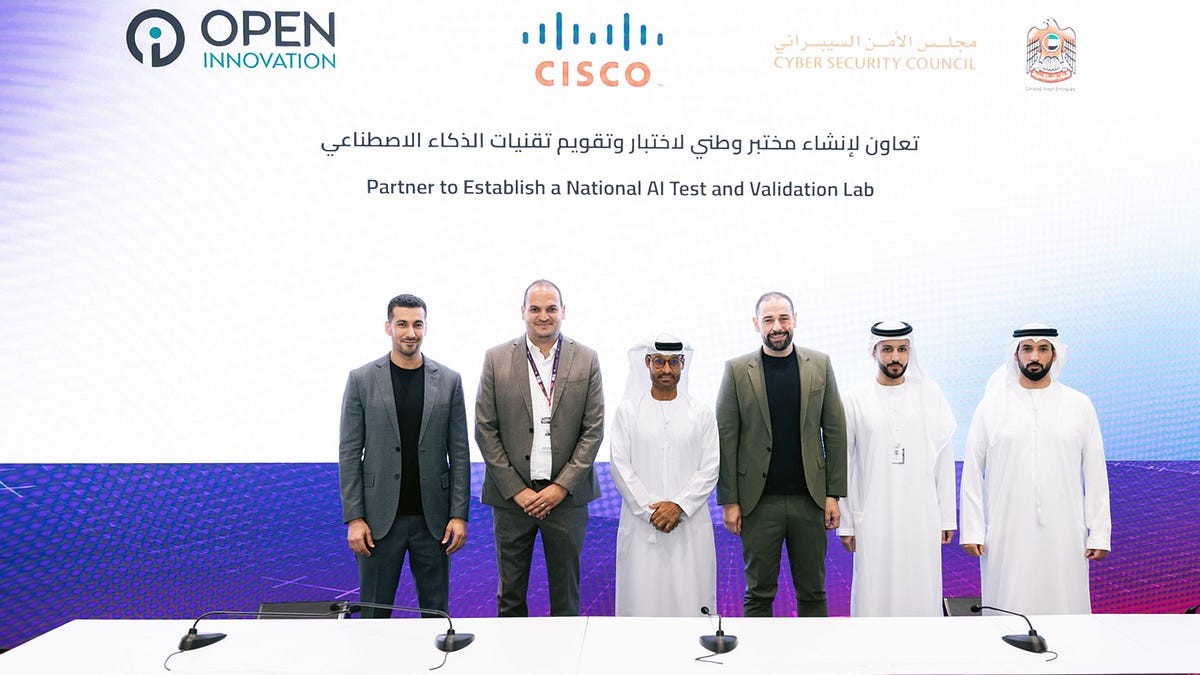
The United Arab Emirates has established a pioneering facility designed to rigorously test, validate, and certify artificial intelligence systems. This National AI Test and Validation Lab represents a significant milestone in global AI governance, offering a sovereign solution to the growing challenges of AI security, safety, and reliability.
Hosted in the Emirates and governed by the UAE Cyber Security Council, the lab is a collaborative effort involving global technology leaders Cisco and Open Innovation AI, alongside national telecommunications provider Emircom. Its primary mission is to provide a standardized verification process for AI models, agents, and applications deployed across government, critical infrastructure, and the private sector.
Why This Matters: The Shift from Pilot to Production
As artificial intelligence evolves from experimental pilots to core operational infrastructure—particularly with the rise of agentic AI (systems capable of autonomous decision-making)—the question of trust becomes a matter of national security.
In this new landscape, an AI system is no longer just a software tool; it is critical infrastructure. If an autonomous agent can be manipulated, hacked, or biased, the consequences can range from financial loss to physical harm. The UAE’s initiative addresses this by creating a verifiable assurance layer. By centralizing testing under national standards, the UAE ensures that AI systems deployed in sensitive sectors are not only functional but also secure and compliant. This capability places the UAE among the few nations worldwide with a dedicated, scalable infrastructure for mass AI validation.
How the Lab Works: Rigorous Testing Standards
The facility is already operational and designed for high-volume throughput, with the capacity to analyze tens to hundreds of thousands of AI agents annually. This scalability is crucial for supporting the UAE’s accelerating adoption of AI across all economic sectors.
To earn the national certification mark, AI systems must pass comprehensive evaluations covering six key areas:
- Model Security: Ensuring the core architecture is robust against manipulation.
- Threat Defence: Specifically targeting vulnerabilities like prompt-injection attacks and jailbreak attempts, which are common risks as AI systems gain more autonomy.
- Data Integrity: Verifying that the data used for training and operation is secure and uncorrupted.
- Supply-Chain Security: Assessing the safety of third-party components and dependencies.
- Agent Autonomy: Testing how well the AI behaves when making independent decisions.
- Regulatory Compliance: Ensuring adherence to legal and ethical frameworks.
Global Credibility Through Dual Alignment
A key strength of the lab is its alignment with both local mandates and international best practices. Assessments are conducted against UAE national cybersecurity policies as well as major global standards, including:
- ISO 42001 (AI Management Systems)
- MITRE ATLAS (Adversarial Threat Landscape for Artificial-Intelligence Systems)
- NIST AI RMF (AI Risk Management Framework)
- OWASP frameworks for Large Language Models (LLMs) and AI agents
This dual approach means that systems certified in the UAE do not just meet local requirements; they also possess broader global credibility, facilitating easier international deployment and partnership.
Technical Infrastructure and Scope
The lab’s technical backbone combines Cisco’s AI-ready secure networking and high-performance NVIDIA GPU compute with Open Innovation AI’s specialized software platform. This includes tools for orchestrating complex AI workloads and automated “red-teaming” (simulating attacks to find weaknesses).
The facility serves a wide ecosystem of stakeholders:
* Government Entities: Federal and local agencies deploying AI for public services.
* Critical Infrastructure: Operators in energy, telecommunications, and transport.
* Private Sector: Financial services, healthcare, and other industries adopting AI at scale.
* Developers: UAE-based AI creators seeking certification before launching products to market.
Conclusion
By establishing the National AI Test and Validation Lab, the UAE has moved beyond theoretical regulation to practical enforcement. This facility provides a clear, standardized path for ensuring that AI systems are safe, secure, and trustworthy before they impact society. As agentic AI becomes ubiquitous, such sovereign validation capabilities will likely become a benchmark for global AI governance.