It’s the first time. A US tech company bought advanced cryptographic AI tools developed entirely in the UAE.
San Francisco-based OPAQUE scooped the technology from the Technology Innovation Institute (TII ), which answers to Abu Dhabi’s Advanced Technology Research Council. It’s a clean sale. No fluff. Just foundational code moving from the Middle East to the Bay Area.
And the numbers aren’t small.
OPAQUE, born out of UC Berkeley’s labs and valued at $300 million, just added confidential model training and post-quantum protection to its platform. ServiceNow uses them. Anthropic knows them. Accenture trusts them.
SO WHAT?
Here’s the rub: companies are sitting on mountains of data. Patient records. Bank logs. State secrets.
They can’t feed that garbage into public AI models. It’s illegal. Or dangerous. Usually both.
Most enterprises try to fix this by patching together point solutions. One tool for training. Another for inference. A third for agent execution.
It’s a nightmare.
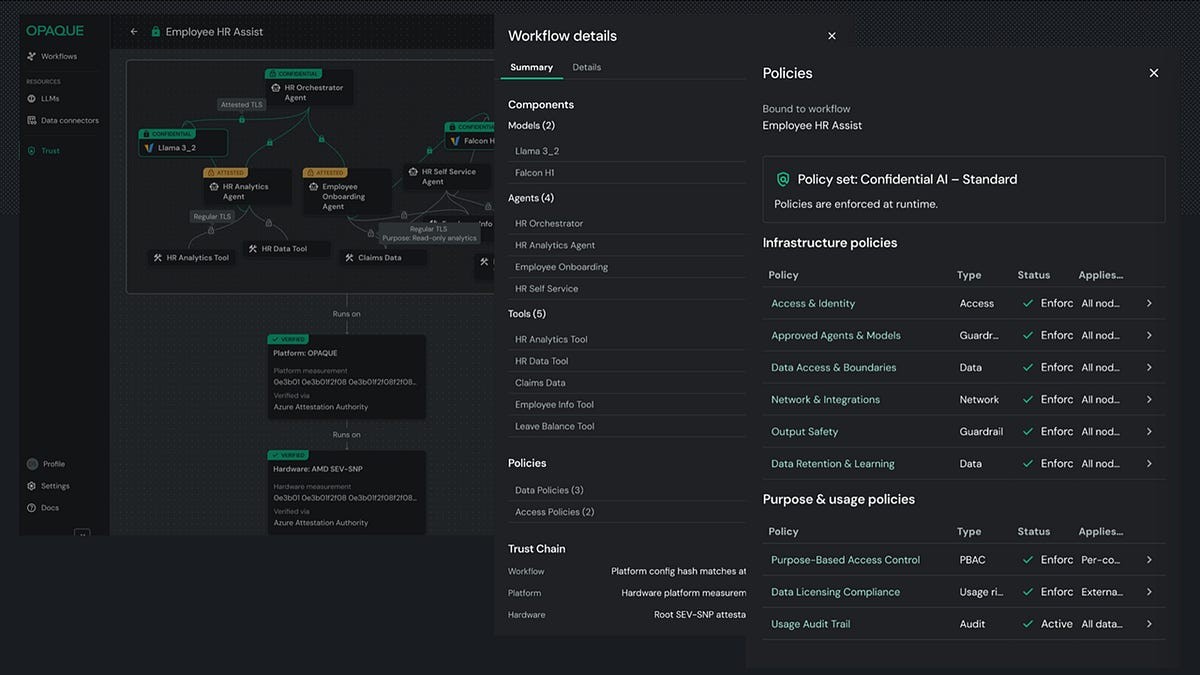
The pieces don’t fit. Compliance gaps appear overnight. Security holes open up like Swiss cheese. OPAQUE just stitched it all up in one go. Hardware-enforced. Verifiable.
For Abu Dhabi, this proves they aren’t just buying AI anymore.
They’re building the pipes it runs on.
THE DETAILS
H.E. Faisal Al Bannai oversaw the deal. The acquisition adds two heavy hitters to OPAQUE’s stack:
- Confidential AI training. Using multi-party computation and fully homomorphic encryption, you can train models on raw data without ever exposing that data. Not to the cloud provider. Not to the developer. Not even to OPAQUE.
- Post-quantum shields. Quantum computers will eventually break current encryption standards. This tech protects workloads against those future threats, too.
Before this? Enterprises were forced to juggle vendors. Now it’s a single platform.
Training. Fine-tuning. Inference. Agent execution.
All covered by cryptographic guarantees.
The security isn’t based on trust. It’s hardware-enforced. Trusted Execution Environments lock the data down. Attestation proves it’s safe.
Can OPAQUE look at the data?
No.
Can you deploy it on sovereign cloud infrastructure? Yes. With cryptographic proof of where the data actually lives.
This generates evidence aligned with SOC 2, ISO 27001, and the EU AI Act. It ticks the boxes for GDPR Article 32. It handles the high-risk regulatory hurdles that usually block AI deployment.
It’s already working.
ServiceNow runs this in production. They’re extending AI capabilities to clients without exposing sensitive enterprise data.
Imagine healthcare systems training diagnostic models across different countries. Banks tracking fraud across borders. Defence contractors tweaking models on classified intel.
OPAQUE says they move these deployments four to five times faster now.
Four. To. Five.
THE BIGGER PICTURE
Announced at Make It In The Emirates, this is a flex.
Abu Dhabi is positioning itself as an exporter of high-tech infrastructure. Not just a consumer.
For the ATRC, this validates a specific strategy. Invest in foundational cryptography. Prove it on world-class models. Commercialize via partners with scale.
It worked. TII’s code is now live globally.
In financial services. Healthcare. Government.
The TII Cryptography Research Centre is one of the only major crypto hubs outside Europe and North America that can pull this off.
They partner with Yale, NYU, and Ruhr University Bochum.
But the real flex?
They’re shaping the US NIST post-quantum standards. The very rules the rest of the world will use to secure its digital future.
So we go from theoretical math in Abu Dhabi labs to encrypted enterprise software in California servers.
A pretty straight line.
But where does the code end up?
Probably on a server you don’t control. Doing things you can’t see.
That’s the trade-off, right?