
If you grew up watching movies on VHS, the arrival of DVD felt like a miracle. Suddenly, the grainy, stretched images were crisp. The audio didn’t sound like it was coming from a tin can. You could pause a scene without the picture warping into a digital mess. You could skip chapters. You could even watch a director explain what he meant by that weird shot in the third act.
It seemed like the peak of home entertainment. Why fix what wasn’t broken?
Then came bigger TVs.
Most consumers didn’t realize their standard definition discs looked terrible on screens larger than 36 inches. The pixels showed. The blurriness became obvious. To fill those expansive living room screens with sharp images, you needed more data. You needed a format that could hold high-definition video.
Enter HD-DVD.
The concept was straightforward. It looked like a DVD. It acted like a DVD. But it packed significantly more punch. While a standard DVD holds about two hours of video, an HD-DVD could store between four and eight hours of content.
“HD-DVDs look best on screens that are smaller than 36 inches… they’re not always up to the challenge of today’s high-definition sets.”
If you understand how a DVD works, you already understand the basics of HD-DVD. Both formats store data as microscopic pits arranged in a long spiral. A laser reads these pits from the reverse side. To the laser, the pits look like bumps. These bumps reflect light to a sensor. The player’s electronics convert that reflection into a digital signal.
An HD-DVD player is essentially a DVD player with upgraded eyes. It doesn’t just convert signals to analog; it can send them digitally, preserving the integrity of the high-definition image.
The Numbers Game
The difference isn’t just in how the data is read, but how much can be stored. The physical technology allowed for massive jumps in capacity.
- Single-layer HD-DVD: 15 GB
- Dual-layer HD-DVD: 30 GB
- Single-layer DVD: 4.7 GB
- Dual-layer DVD: 8.4 GB
That capacity jump meant more than just longer movies. It meant room for multiple audio tracks, commentary, and behind-the-scenes extras without sacrificing picture quality.
Compression Matters
Capacity is only half the story. You also need efficient compression to fit high-definition video onto a disc. HD-DVDs supported MPEG-2, MPEG-4, and VC-1 codecs. This flexibility allowed studios to balance file size with visual fidelity.
On a 15 GB disc, you could get about four hours of high-definition playback. Double the space with a dual-layer 30 GB (or 50 GB in some marketing contexts, though the tech spec listed 30 GB max for dual layer) and that jumps to eight hours.
But capacity alone doesn’t win wars. Players do. And in the case of HD-DVD, the players faced stiff competition from Blu-ray.


How Blue-Violet Lasers Shrink Data Tracks
The mechanics behind an HD-DVD aren’t magic. They rely on the same basic physics as a standard DVD: a reflective layer with microscopic bumps. A laser hits these bumps, bounces back to a sensor, and gets converted into a digital signal. Physically, the disc is identical to its predecessor. It’s still 120 millimeters wide and 1.2 millimeters thick.
But look closer at how it stores data. Three specific changes allow HD-DVDs to pack significantly more information into that same footprint.
First, they ditch the red laser for a blue-violet laser. Second, the pits (the indentations) are smaller, and the spiral tracks holding them are packed tighter. Third, the data compression is far more efficient.
The Physics of Track Pitch
Changing the laser color might seem like a minor hardware tweak, but it’s the linchpin for everything else. The blue-violet laser operates at a wavelength of 405 nanometers, compared to the 650-nanometer red laser used in standard DVDs. Shorter wavelengths can focus on smaller targets.
This precision allows for a much narrower track pitch — the distance between the spiral lines of data. A standard DVD has a track pitch of 0.74 micrometers. An HD-DVD shrinks that to 0.40 micrometers. Think of it this way: writing a document with a broad magic marker versus a fine-tipped pen. You can fit far more words on the page with the pen.
Compression Wars: MPEG-4 and VC-1
The second major upgrade is how the video data is compressed. Traditional DVDs rely on MPEG-2. It’s a proven format, but it’s bloated by modern standards. HD-DVDs can technically support MPEG-2, but they default to MPEG-4 (specifically H.264/AVC in many implementations, though the source highlights general MPEG-4 efficiency) or VC-1 (Microsoft’s Windows Media Video 9).
These newer codecs are significantly more efficient. They preserve higher video quality while requiring far less storage space. This efficiency is what makes high-definition video feasible on a disc of this size.
Speed and Digital Signal Integrity
Hardware improvements have also accelerated the read process. An HD-DVD player can retrieve information and send it to the display roughly three times faster than a DVD player.
More importantly, these players connect to HDTVs using the High Definition Multimedia Interface (HDMI). This is a purely digital connection. It bypasses the analog conversion steps that plague older setups. Analog conversion inevitably introduces noise and quality loss. HDMI keeps the signal pure from disc to screen.
DVD Compatibility
Now for the practical question. With all this new tech, what happens to your existing library of DVDs? Will they become worthless paper discs?
The industry didn’t just build backwards-compatibility into HD-DVD players by accident. Most HD-DVD players are designed to read standard DVDs. The blue-violet laser is also capable of reading the larger pits and wider tracks of older discs. So, you don’t need to replace your entire collection overnight.
Defining Standard vs. High Definition
To understand why the upgrade matters, you need to look at resolution. Standard Definition (SD) uses 525 lines of pixels from top to bottom. High Definition (HD) supports up to 1125 lines.
Not all 1125 lines are visible on every screen. Some are part of the signal overhead. But the difference in detail is stark. SD looks fine on a small CRT TV. On a large, flat-panel HDTV, SD often looks soft or blurry. HD utilizes that screen real estate.
When you play a standard DVD on an HD-D

Let’s say you bought an HD-DVD player the second they hit shelves. You’d still be able to pop in your old DVDs. It just worked. But the reverse wasn’t true. If you bought a movie on the new HD-DVD format, your existing DVD player couldn’t touch it. The discs were identical in size and shape. This made backward compatibility straightforward for manufacturers. They simply needed a laser pickup capable of reading both formats. The Toshiba HD-DVD player launched in April 2006 did exactly this. It handled DVDs, HD-DVDs, and CDs without breaking a sweat.
Why Standard DVDs Survived
Even if HD-DVD had won the format war, standard DVDs wouldn’t have vanished. Most American households simply didn’t have HDTVs. The upgrade path made little sense without a screen capable of showing the difference. There was no point in buying high-definition media if you were watching it on a CRT or standard definition set.
Twin Format and Combination Discs
Manufacturers found two clever ways to mix old and new content on a single physical object.
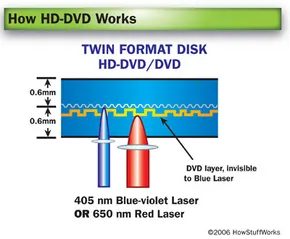
Twin format discs used two layers. The top layer was a standard DVD. A red laser read it. The bottom layer held HD-DVD content. A blue laser read that. The outer layer remained transparent to the blue light. This allowed a single drive to access both formats by switching lasers.
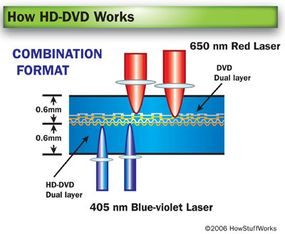
The other option was a combination format disc. This was a two-sided design. One side held the DVD. The other held the HD-DVD. You flipped the disc over. The drive’s red laser read the DVD side. The blue laser read the HD-DVD side. Both methods solved the compatibility headache. They kept libraries intact. They also kept hardware relevant longer.

The Format War: Blu-ray vs. HD-DVD
Twin discs were supposed to be the bridge. A single physical medium playable on standard DVD players and high-definition units alike. If the market had adopted them, early adopters could have upgraded their living room setups without discarding their existing collections. Rental shops and libraries loved the idea too. They could serve customers who weren’t ready for the leap while keeping the door open for the future.
Then HD-DVD died.
The format collapsed under the weight of corporate backing and consumer hesitation. Today, that “what if” is a dead end. Consumers are left relying on Blu-ray/DVD hybrid players. It’s the only path forward that maintains backward compatibility with the massive library of standard DVDs.
But before the dust settled, there was a war. A brutal, expensive battle for the living room. On one side, Toshiba and its allies backed HD-DVD. On the other, Sony, Panasonic, and Samsung championed Blu-ray. Both sides believed the other would crumble. The industry split down the middle. Studios picked sides. Consumers got confused.
So, what actually separated them? It wasn’t just marketing.
The Upscaling Advantage
Let’s look at the hardware capabilities, specifically up-conversion. This feature changed how older content looked on new screens.
Standard DVDs output at 480i or 480p. That resolution looks sharp on a 27-inch CRT TV. It looks muddy on a 50-inch plasma or LCD panel. The gap between 480-line analog displays and modern 720p or 1080p screens is massive.
Toshiba’s HD-DVD players included a powerful up-conversion engine. You could pop in an old, scratched DVD of The Godfather. The player wouldn’t just mirror that 480p signal. It would process the image, interpolating pixels to fill a 720p or 1080p display.
Did it match the clarity of a native HD-DVD disc? No. The native disc had far more data. But was it better than the raw analog signal from a 1998 DVD player? Absolutely. It reduced jagged edges. It smoothed out noise. For anyone holding onto their DVD collection, this was a killer feature. It extended the life of the format in their eyes.
Sony and Blu-ray had upscaling too, but the implementation and quality varied by manufacturer. Toshiba’s approach was integrated deeply into the HD-DVD standard, making it a consistent selling point.
Why It Matters Now
You might wonder why this matters if HD-DVD is gone. It matters because it shaped the hardware we use today.
The failure of HD-DVD didn’t just kill a format. It killed the idea of dual-format discs becoming the standard. We didn’t get a unified high-definition ecosystem where one disc worked everywhere seamlessly. Instead, we got fragmentation.
When a Blu-ray/DVD hybrid player fails, you lose access to both. When an HD-DVD player failed, it became e-waste overnight.
The up-conversion technology developed during that war is now standard. Every modern smart TV, every streaming stick, every Blu-ray player upscales content. We take it for granted. But that capability was refined in the trenches of the format war.
The


Why HD-DVD Lost the Format War
The early 2000s saw a brutal clash for high-definition dominance. It wasn’t just about better pictures. It was a corporate bloodbath. HD-DVD and Blu-ray were the main contenders. Critics compared it to the VHS versus Betamax war of the late 1980s. But the stakes were higher. The technology was newer. The industry was fragmented.
Both formats shared a core similarity. They used blue lasers instead of red ones. This allowed for tighter data pits and higher density. Both also supported similar video and audio compression standards. On paper, they looked like twins separated at birth.
But they weren’t identical.
Blu-ray discs offered significantly more storage space. A dual-layer Blu-ray held 50 GB. HD-DVD maxed out at 30 GB. That extra capacity mattered. It meant more bonus features. It meant higher bitrate movies. It meant future-proofing.
The Corporate Divide
Who controlled the standards? The DVD Forum, which manages the original DVD standard, approved HD-DVD. It rejected Blu-ray. Toshiba, the primary driver of HD-DVD, held a seat on the DVD Forum Steering Committee. This gave them institutional leverage. They argued HD-DVD was the logical successor to the format they already owned.
Blu-ray had its own alliance. The Blu-ray Disc Association. Its board included Sony, Pioneer, Dell, Apple, Disney, and Fox. The motion picture industry largely backed Blu-ray. Why? Piracy. New manufacturing equipment for Blu-ray meant harder-to-copy discs. Studios feared HD-DVD’s legacy equipment compatibility would make piracy easier.
Price and Timing
Money drove consumer adoption. Initially, HD-DVD was cheaper. Toshiba could use existing production lines. Blu-ray required new factories. Early HD-DVD players cost around $399. They dropped to $290 quickly.
Blu-ray players were expensive at launch. But manufacturing techniques improved rapidly. Prices fell below $300. The timing was tight. HD-DVD players hit stores on April 18, 2006. The first Blu-ray player arrived in the U.S. in June 2006. A two-month head start for HD-DVD. It was enough to win some early adopters. But not enough to win the war.
The Alliances
Toshiba was joined by Microsoft and Intel for HD-DVD. Microsoft released an add-on HD-DVD drive for the Xbox 360 in November 2006. This was a strategic move. Gaming consoles were living room hubs. Control the console, control the format.
Sony countered with the PlayStation 3 in November 2006. It included a Blu-ray drive. The PS3 was expensive. But it bundled a format with a must-have gaming platform. Apple and Dell also entered the fray. They produced Blu-ray players for Macs and PCs. The tech giants were splitting, but the entertainment giants stuck with Blu-ray.
The Skepticism
In the beginning, the outcome wasn’t clear. Critics questioned Blu-ray’s value. They argued the 50 GB capacity was overkill. How much video data could a single movie use? Even with extensive special features, the extra space seemed unnecessary. HD-DVD’s lower price point seemed like the obvious choice for budget-conscious consumers. Many thought the cheaper format would win simply because it was affordable.
But affordability wasn’t everything. The industry had voted. The studios wanted the security of new manufacturing. The tech companies wanted the higher capacity. The gaming consoles were already built for Blu-ray.
The Encoding Myth
If you visited forums during the war, you’d see debates about playback times. Toshiba claimed a 30 GB HD-DVD could hold eight hours of HD video. The Blu-ray Disc Association claimed a 50 GB disc held eight and a half hours. The math didn’t add up. A disk twice as big held only slightly more data.
This discrepancy wasn’t an error. It was a result of bit rate and encoding. A file with a lower bit rate takes less space. Early Blu-ray tests often used MPEG-2 encoding. MPEG-2 is less efficient than MPEG-4. It wastes space on data that doesn’t add quality. If you use a more efficient codec, you can store more video in less space. The numbers were misleading. They reflected inefficient compression, not physical limits.
The End Game
The battle lasted two years. Toshiba, Microsoft, and Intel pushed hard. They had the price advantage. They had the DVD Forum’s backing. They had a head start. But they lost.
HD-DVD succumbed. The format wars ended in 2008. Today, Blu-ray reigns supreme in the HD physical media market. It survived the price gap. It survived the institutional bias. It survived the skepticism.
How did it happen? The answer lies in the next section.


The Tipping Point
Retailers hated the stalemate. They couldn’t justify dedicating prime floor space to two competing high-definition formats, and the risk of backing the wrong horse was too high. The industry needed a winner.
By summer 2007, the momentum had clearly shifted toward Blu-ray. Sony’s PS3, bundled with a Blu-ray drive, did the heavy lifting for adoption. Sales data from the first half of 2007 showed Blu-ray discs outselling HD-DVDs by a two-to-one margin.
“HD-DVD wasn’t ready to throw in the towel just yet.”
Yet, the format war dragged on. Studios like Paramount and DreamWorks hedged their bets, releasing content for HD-DVD exclusively, though Spielberg’s Paramount films still appeared on Blu-ray. The gap widened, but Toshiba refused to fold.
Then came the retail kill shots.
Blockbuster switched its entire high-definition inventory to Blu-ray. Target followed, dropping HD-DVD players to make room for Sony’s format. Bloggers and tech journalists immediately declared HD-DVD dead.
But the price point kept it alive. Toshiba’s players were cheaper than dedicated Blu-ray machines. Some experts predicted the war would last until 2009. Plans for dual-format players were abandoned, but hope lingered in the lower price tag.
Warner Bros. Breaks the Spell
The tide turned sharply in early 2008.
Warner Bros. announced it was moving exclusively to Blu-ray. This was a massive blow. Suddenly, HD-DVD was left with only two studio backers: Universal and Paramount.
Universal’s exclusivity agreement had just expired. Paramount’s contract had an escape clause tied directly to Warner Bros.’ move. If Warner jumped, Paramount could follow.
They did.
The CES Ghost Ship
The writing was on the wall at the 2008 Consumer Electronics Show.
Toshiba canceled all press conferences and major events for its format. Its presence was reduced to a small booth. Meanwhile, Blu-ray’s booth was a massive, ghostly pirate ship.
Wal-Mart announced it would stock only Blu-ray discs and players.
In February 2008, Toshiba officially conceded. It announced it would stop manufacturing HD-DVD players by March. The format war was over.
Not Dead Yet
The story didn’t end there.
In China, manufacturers threw their support behind CH-DVD, an offshoot of the HD-DVD standard. Did this resuscitate the format?
Hardly. The war with Blu-ray had already been won. But the existence of CH-DVD proves that regional variations can keep legacy tech lingering in the shadows long after the mainstream battle is decided.
Why the Format War Eventually Ended
The dust has settled on what was arguably the most expensive marketing battle in consumer electronics history. If you are looking for a breakdown of how the HD DVD vs Blu-ray battle concluded, the answer lies in a combination of retail momentum and corporate surrender.
It wasn’t a technical knockout. It was a business collapse.
The Retail Shift That Killed HD-DVD
By late 2007, the writing was on the wall for Toshiba. The format had failed to secure the broad retail distribution that Blu-ray locked down early on.
Target made a decisive move. In July 2007, they announced they would stock only Blu-ray set-top players. 🎯
This wasn’t just about one store. It signaled to the market that Blu-ray was the standard. Blockbuster followed suit, declaring their support for the disc format. Then came the biggest hammer blow.
Wal-Mart backed Blu-ray.
Big retailers control the shelf space. Without it, HD-DVD couldn’t reach the mainstream consumer.
Studio Support Was Thin on the Ground
You need movies to sell players. You need players to sell movies. It’s a cycle.
Blu-ray had the major studios locked in. HD-DVD had two: Warner Bros. and Paramount. That’s it.
Disney, Sony, Universal, and 20th Century Fox were all in. When Disney announced support for HD-DVD in August 2007, it looked like a win for Toshiba. But it was a bluff. A desperate, final stand.
By early 2008, the facade crumbled.
Toshiba Calls It Quits
The end came fast.
On February 16, 2008, Reuters broke the news. Toshiba announced it would give up on HD-DVD. The format war was over.
Toshiba cited the lack of support from major studios and retailers. They couldn’t compete with the ecosystem built by Blu-ray.
It wasn’t a sudden technical failure. It was a slow bleed of confidence.
What Happened Next?
HD-DVD didn’t vanish overnight. There were whispers of a resurrection in China. CNet reported on this in July 2008. But it never gained traction.
The market had moved on. Consumers bought Blu-ray players. Studios released Blu-ray discs. The infrastructure was built.
Where Did This Leave You?
You got a better picture. Blu-ray offered 1080p resolution. HD-DVD offered a similar spec sheet on paper, but with less content.
The technical differences were minor. The real difference was adoption.
If you bought an HD-DVD player in 2007, you bought a device for a format that died in 2008. You paid a premium for a dying standard.
Blu-ray won because it had the backing of Sony, Disney, and Walmart. It wasn’t about better lasers. It was about better business.
How It Connects to Your Tech Today
Why does this matter now?
Because it set the precedent for format wars. It showed that technical superiority doesn’t guarantee victory. Ecosystem wins.
We see this again with streaming services. We see it with electric vehicle charging standards. The lesson remains the same.
The side with the most partners, the most retail space, and the most content wins. Not the side with the best spec sheet.
Related Articles and Deep Dives
If you want to dig deeper into the tech that made these formats possible, look here:
- How Blu-ray Works : The laser technology behind the winner.
- How Holographic Versatile Discs Work : The format that never stood a chance.
- How DVDs Work : The standard that HD formats replaced.
- How HDTV Works : The display technology that drove demand.
- How Ultra-high Definition Works : The successor to Blu-ray.
- How LCDs Work : The screen tech in most modern TVs.
- How DLP Sets Work : Another projection method you might encounter.
Sources and Further Reading
For the hard data behind this history, these are the primary sources that documented the collapse:
- Ault, Susanne. “Target stores to stock only Blu-ray set-top players.” Video Business. July 26, 2007.
- Bangeman, Eric. “HD DVD and Blu-ray deadlock to continue into 2009… at least.” Ars Technica. Sep. 25, 2007.
- Barnes, Brooks. “Two Studios to