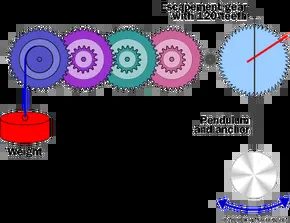
Turning back the clock every 20 minutes is annoying. You want a clock that lasts a week, not a minute. The solution lies in gear ratios. By creating a high-ratio gearbox, you can slow down the drum significantly. Imagine a drum that rotates every six or twelve hours. Suddenly, all you have to do is rewind the clock every week.
The calculation is simple. When the transmission ratio of the weight drum and escapement gear is about 500:1, the clock keeps the time accurately without constant attention. Consider a specific setup: an escapement wheel with 120 teeth and a pendulum with a half-second period. The second hand is attached directly to this gear. The gear ratio of each gear in the weight’s train is 8:1. If you multiply them, you get a total ratio of 492:1. Close enough to 500:1 for practical purposes.
Building the Hands
When the seconds start ticking, you need minutes and hours. You don’t need new mechanisms, just more gears. Connect another gear with a gear ratio of 60:1 to the escapement. Attach the minute hand to the last gear of this sequence. Do the same for the hour hand, but use a 12:1 ratio.
Presto. You have a working clock. It ticks. Hands move. It looks complicated, but it’s just geometry and leverage.
However, this basic design has two serious flaws. First, the hands land on different axes. The second hand rotates on one axis, the minute hand on another and the hour hand on the third. This is messy. Clockmakers solve this problem by using tubular stems. They align the gears so that their drive stems have the same central axis. One tube sits inside another. Look at any traditional clock face. You can see this nested arrangement. It looks clean because it is physically integrated.
Winding problem
The second problem is harder to ignore. Since all the gears are locked together, you cannot wind or adjust the clock without stopping the hands. This is a significant usability issue. The solution is a slipping gear. This mechanism allows you to detach part of the train.
Think of a wristclock. When you pull the stem to set the time, you activate the slipping mechanism. It separates winding gears from timekeeping gears. In the diagram above, imagine temporarily removing the little black gear from the train. You remove it to wind the clock. You put it back to let it run. This simple procedure solves the setting problem without affecting the accuracy of the timekeeping.
The five parts of the clock
It’s easy to get lost in brass and springs. But when you remove the case, the pendulum clock is very simple. There are only five basic components. Understand these, the rest is just details.
- Weight or spring : This is a source of energy. It offers the power to turn hands. Without it, the clock is dead.
- Weight gear train : This high ratio gear increases the movement of the weight drum. This ensures that you don’t have to constantly turn the clock back.
- Escapement : This is the heart of control. It consists of a pendulum, anchor and escapement gear. It precisely controls the release of energy from the weight. No escapement, no timekeeping.
- Hand gear train : This reduces speed. It ensures that the minute and hour hands rotate at the correct speed. Seconds in a minute. minutes per hour.
- Adjustment mechanism : This disengages, slips or locks the transmission. This allows you to rewind the clock and adjust the clock without stopping the internal timing logic indefinitely.
When you see these pieces, the complexity disappears. Clocks are easy. At least it seems so.