You may have heard the terms AM radio, FM radio, VHF, UHF television, or citizen band (CB). But what do they actually mean? Why are there so many different names and numbers? The core of a radio wave is an electromagnetic wave that travels through an antenna. These waves operate at different frequencies. By tuning the receiver to a specific frequency, a single signal can be isolated from the noise.
In the United States, the Federal Communications Commission (FCC) regulates this interference. They decide who can use which frequencies and grant licenses to stations. So when the announcer says, “You’re listening to 91.5 FM WRKX,” three pieces of data are passed to you. You will hear a frequency modulated (FM) signal with a frequency of 91.5 MHz. The FCC call sign for this station is WRKX. 91.5 MHz means that the transmitter vibrates 91,500,000 times per second.
All FM stations occupy the same spectrum (88-108 MHz). Other technologies are not allowed on this frequency. Precisely reserved for FM radio.
AM radio is different. It operates in a much lower frequency range of 535 to 1700 kHz. This corresponds to 535,000 to 1,700,000 cycles per second. If a station says “AM 680 WPTF”, it is broadcasting an amplitude modulated (AM) signal at 680 kHz.
Spectrum segmentation
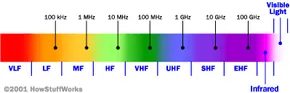
Every wireless device you can imagine has its own little corner of the wireless spectrum. There are hundreds of such bands. The general distribution is as follows:
- AM radio: 535 kHz – 1.7 MHz
- Shortwave radio: 5.95 MHz – 26.10 MHz
- Citizen Band (CB) radio: 26.965 MHz – 27.405 MHz
- TV channels 2–6: 54–88 MHz
- FM radio: 88 MHz to 108 MHz
- TV channels 7–13: 174–220 MHz
But it goes even deeper. Garage door openers and alarm systems typically use frequencies of around 40 megahertz. Cordless phones use the frequency bands 43-50 MHz as well as 900 MHz, 1.9 GHz, 2.4 GHz and 5.8 GHz.
Mobile phones operate on frequencies of 824-849 MHz. The frequency of the baby monitor is approximately 49 MHz. If you’re flying a radio controlled airplane, you’re probably using 72 megahertz. Remote control car? About 75 MHz. Wildlife researchers use tracking collars to transmit data at a frequency of 215-220 megahertz.
Air traffic control radar frequencies vary between 960 and 1,215 megahertz. The Global Positioning System (GPS) uses the frequencies 1,227 MHz and 1,575 MHz. Deep space communication also has its own narrow band of 2,290 MHz to 2,300 MHz.
Why were these specific frequency ranges chosen?
If FM radio operates at high megahertz frequencies, why does AM radio stay in low frequency ranges? It seems very relaxed. In many ways it is true. History determines the course of divisions.
AM radio has been around since about 1906. The AM frequency division was defined in the 1920s. The regulatory authority, eventually named the FCC, was established by Congress in 1927. At that time, radio and electronic technology were still in their infancy. Because of the limited tools available, it was easier to generate and transmit low-frequency signals.
Television didn’t really exist until 1946. The FCC began assigning commercial broadcast bands to television at that time. By 1949, one million Americans owned a television. By 1951, the number had risen to ten million.
FM radio was invented by Edwin Armstrong. He wanted to solve the problem of static interference characteristic of AM broadcasts and enable high-fidelity music transmission. He founded the first FM station in 1939, but it didn’t become popular until the 1960s. By then the technology had developed enough to handle higher frequencies. That’s why FM got to use higher frequency ranges.
Understanding Radio Frequency Scanners
您家中的大多数收音机都是单一用途设备。 AM 收音机只能收听 535-1,700 千赫兹的声音,仅此而已。 FM 收音机的频率为 88-108 兆赫。 CB 无线电仅限于 40 个特定频道。
扫描仪不同。 它们是频率范围极宽的接收器。 他们几乎可以听到空中的任何信号。
大多数人使用扫描仪来收听当地警察、消防和紧急通信。 这就是为什么它们通常被称为“警察扫描仪”。 但您可以将它们用于更多用途。 您有两个主要选择:
- 扫描模式: 扫描仪扫描一系列频率。 仅当检测到活动时它才会停止。 如果您正在跟踪警察动向,您可以将其设置为扫描当地警察频率。 当巡逻车报告事件时,扫描仪会锁定,您会听到对话。
- 直接频率: 您可以输入特定频率。 想听当地机场的空中交通管制吗? 将扫描仪调整到该精确频率。 由于扫描仪覆盖的范围很大,因此您几乎可以接收到空中广播的任何内容。
为了有效地使用扫描仪,您需要良好的频率表。 您需要知道操作发生在哪里。
Related blog posts
-
How the radio scanner works
-
How the radio works
-
How Ham Radio Works
-
How does the EPIRB emergency radio work?
-
How Bluetooth works
-
Can certain radio frequencies cause health risks?
-
Why do some radio stations sound better at night than during the day?
-
How Internet Radio Works
-
How satellite radio works
More Great Links
-
Spread Spectrum Scene
-
NTIA: Office of Spectrum Management
-
FCC Radio Spectrum home page
-
Allocation of Radio Spectrum in the United States