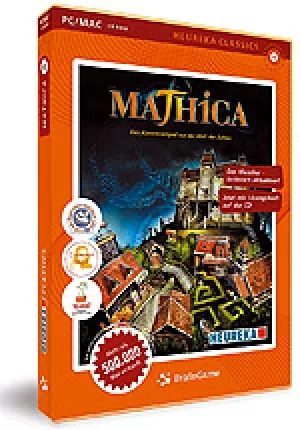
Mathica is one of those rare educational titles that actually respects your time. It’s an adventure game that doesn’t feel like homework in disguise. The visuals are striking. Atmospheric. The kind of graphics that make you stop and look at the background art instead of just rushing to the next puzzle. It sets a mood that is surprisingly immersive for a game supposedly about numbers.
But the real draw isn’t just the pretty pixels. It’s the interactive knowledge section. This isn’t a dry textbook sidebar. It’s a curated collection of mathematical phenomena designed to be played with. You’re not memorizing formulas. You’re manipulating concepts.
The scope is surprisingly broad. We’re talking about secret codes. Combinatorics. Probability theory. Even those weird “magic numbers” that appear in nature and history. The game takes these abstract ideas and makes them tactile. You see how they work. You interact with them. It’s engaging.
How Mathica Changes the Learning Curve
Why does this matter? Because traditional math education often kills curiosity. It focuses on rote calculation. Mathica flips that. It uses the adventure framework to drive discovery. You solve puzzles that require an understanding of probability. You crack codes that rely on combinatorial logic.
The result is a sense of flow. Flow state is hard to achieve when you’re bored. It’s easy when the problem feels like a mystery you need to solve to progress. The game leverages this. It wraps dry subjects in narrative stakes.
“So much fun math has never had before.”
That’s the pitch. And it holds up. The interface is intuitive. The puzzles scale in difficulty without feeling unfair. You learn by doing. Not by reading.
Who Is This For?
It’s not just for kids. Sure, the aesthetic is accessible. But the depth of the interactive sections appeals to anyone who has ever wondered why math works the way it does. It’s for the tech-savvy reader who wants to see algorithms in action. It’s for the casual gamer who wants a brain teaser that doesn’t require a degree in computer science.
The game covers enough ground to keep things fresh. Probability puzzles might follow a combinatorics challenge. Then you’re into cryptography. The variety prevents fatigue.
The Atmosphere Matters
Don’t underestimate the graphics. In a genre crowded with minimalist designs, Mathica goes for mood. The lighting. The color palettes. They create a world that feels lived-in. This isn’t just a screen with boxes and numbers. It’s a place. That immersion keeps you engaged longer than you’d expect.
It’s a reminder that education doesn’t have to be sterile. It can be exciting. It can be beautiful. And it can be genuinely fun.
Mathica doesn’t just teach you math. It makes you want to understand it. That’s a rare feat.
The curse on Mathica isn’t magical. It’s computational. Her father, Professor Numerus, didn’t just leave a riddle. He left a logic trap. And the only way out is through the math.
This is the second half of the Lernadventures experience from wissen.de. You already cracked the first half. Now you face seven dense chapters. The goal remains the same: break the spell. The method? Pure logic and number theory.
Decoding the Hidden Layers
You aren’t just reading a story. You’re solving it. The narrative treats mathematical concepts as physical barriers. Each chapter isolates a specific phenomenon. You might encounter secret codes that require frequency analysis. Or probability matrices that dictate your survival odds.
“Only with logic and extensive mathematical know-how can Mathica be redeemed.”
This isn’t theoretical. It’s interactive. The software embeds these problems directly into the plot. If you can’t solve for X, X doesn’t exist in the next scene.
From Probability to Magic Numbers
The curriculum spans the spectrum. You move from abstract probability theory to magic numbers with historical significance. The software explains what these numbers do. Then it forces you to apply them.
Why does this matter to you? Because Lernadventures targets the gap between academic math and real-world application. It doesn’t ask you to memorize formulas. It asks you to use them as tools.
The Structure of the Adventure
The adventure is packaged as a collectible box set. But the digital component is where the weight lies. Seven chapters. Each one a self-contained puzzle environment.
- Secrecy: Cryptography basics applied to narrative clues.
- Chance: Statistical likelihoods affecting story branches.
- Zaubersprüche: The cultural and mathematical history behind so-called “magic” digits.
The learning curve is steep but guided. The interface doesn’t lecture. It presents a scenario. You input the solution. The story advances or resets.
Why It Fits the Wissen.de Ecosystem
This isn’t a standalone game. It’s part of a larger educational infrastructure. The Lernadventures box set positions itself as a bridge. For students who find traditional textbooks dry. For parents looking for structured digital engagement.
The “pretty Mathica” premise is a hook. The rigor is the retention mechanism. Professor Numerus’s curse works because it respects the player’s intelligence. It assumes you can handle the abstraction.
The Real Test
Most ed-tech fails at this point. It simplifies the math too much. It turns logic into a multiple-choice quiz. Lernadventures keeps the friction. You have to think.
If you get stuck, the system doesn’t just give you the answer. It offers clues rooted in the mathematical principles being taught. You learn the why. Not just the how.
Mathica’s fate is sealed in code. Your keyboard is the key. The question is whether you’re ready to type the right sequence.