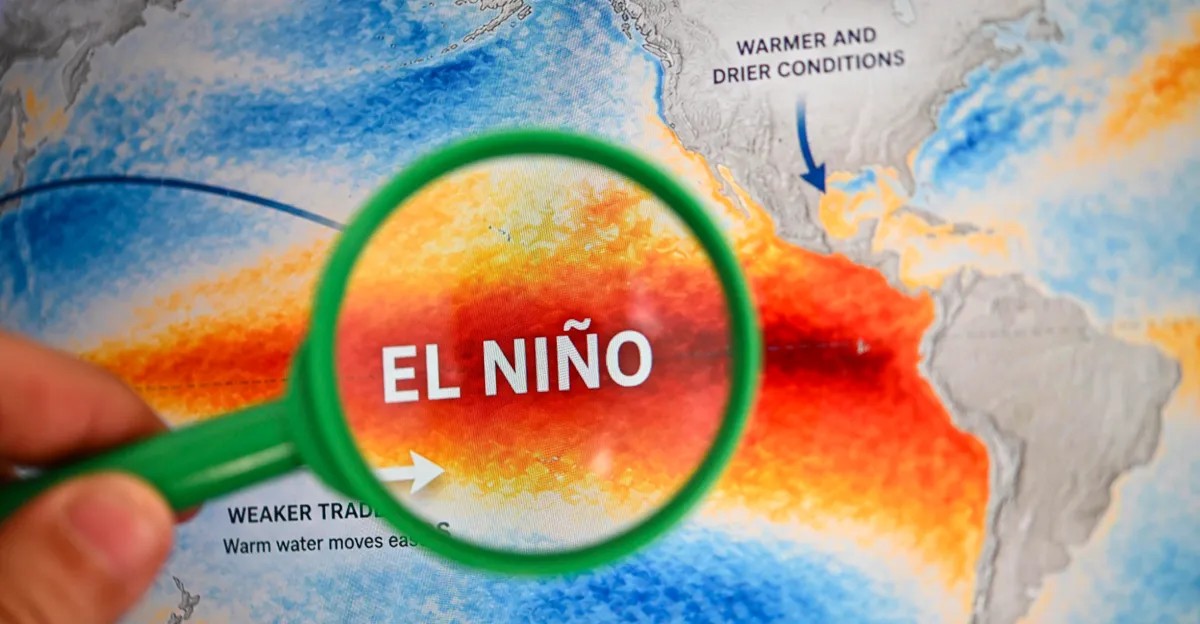
Scientists use a weird name for this. “Godzilla El Niño.”
They aren’t usually into movie metaphors. This means what is brewing in the Eastern Pacific right now is not just a warm year. It is a surge that could make Godzilla El Niño 2025-2026 the hottest year in recorded history. Possibly by a huge margin.
David Wallace-Wells has been thinking about heat for a decade. From The Uninhabitable Earth to his work at The New York Times, he sees a pattern. Next year might not just be a disaster forecast. It could be a preview. A glimpse of what life looks like in 2035, but arriving ten years early. Fire seasons. Atmospheric rivers. Broken monsoons. Strained food systems. All compressed into 365 days.
The numbers are stark. Median projections put 2026 at about 1.7°C above pre-industrial averages. The high-end estimates near 1.9°C. That is a threshold climate models usually saved for the late 2080s. Now? We might see it in under two years.
Sean Illing discussed this on The Gray Area. The tone? Direct. When asked if 2026 will be the real test of our ability to manage climate disruption, Wallace-Wells did not hesitate. He says we will fail. It is bleak. But there is a counter-current. The green energy transition is accelerating faster than expected. Even as political will wavers.
The things that terrified us intoaction not that long ago are now our unavoidable future.
Why the “Godzilla El Niño” is different from past cycles
El Niño is not a new concept. Most of us know the name. Few understand the mechanism until recently.
It is a climatic oscillation. Irregular, but frequent. Every three or four years. Sometimes longer. Warm water pools along the Pacific coast of South America. The effects ripple outward.
How does El Niño affect weather globally?
It disrupts baseline patterns. Western US sees more rain. Brazil and the Amazon face droughts. South Asia monsoons break. Sub-Saharan Africa loses predictable rains. Hurricane activity in the Caribbean drops. It is not uniform badness. It is global disorder.
What is special about this event?
Two things.
1. The baseline temperature is higher than any in modern history. We add the El Niño spike on top of an already feverish planet.
2. The magnitude. Scientists call it a “super” or “Godzilla” event. The heat boost could exceed any similar event on record.
Context matters. El Niños in the 1870s triggered famines killing tens of millions globally. 2026 is not 1878. Our food systems are more robust. But a fertilizer shortage—exacerbated by war in Iran—creates vulnerability. Crop failures in multiple regions are possible. This invites political chaos. Bread riots. Civil unrest. Not inevitably mass death, but significant social fracture.
Will 2026 prove we cannot stop climate change?
We are already at about 1.5°C warming above pre-industrial levels.
1.5 sounds small. On any given day, it feels like nothing. But as a global average, it masks extreme heat, floods, and wildfires.
The Paris Agreement promised to hold warming below 2°C, aiming for 1.5°C. Science warned that 2°C would be catastrophic for the most vulnerable. When the IPCC released those warnings, it sparked the 2019 climate strikes. It gave us Greta Thunberg. Extinction Rebellion. The Green New Deal movement.
Now, the 1.5°C limit is likely breached annually. 2°C looks practically inevitable. We are heading toward a future we defined as unacceptable in 2015, just ten years ago. The fears that mobilized the world are becoming our baseline reality.
What does 1.9C global warming actually feel like?
It feels like failure to prepare. Wallace-Wells argues that 2026 will test our resilience. The result? We will fail. Not necessarily with mass extinction, but with normalization. We will define new levels of suffering as acceptable costs of doing business. We will stop designing a resilient future. We will just endure.
Why climate politics feel confused right now
There is a disconnect. Elite discourse shrinks away from climate. Yet public anxiety is at historic highs.
Polling data is clear. Americans worry more about climate today than they did after Hurricane Katrina. More than during the Bush, Obama, or Bidsen years. The narrative that the country “moved on” is wrong.
Individuals feel the risk. They fear for their communities and children. Politicians and media leaders, however, treat those anxieties as optional. The gap is widening.
Did disasters force action in the past? Not really. Hurricane Katrina sparked a moment of urgency, leading to Obama’s election. He spoke of a healing planet. Since then, disasters come. Public focus spikes. Then fades. The “wake up and forget” cycle repeats.
The question now is not whether people are worried. It is whether worry translates to sacrifice. Or structural change.
Will green energy succeed even with opposition?
Yes. In fact, it is accelerating.
Consider the math. Solar power is cheaper than fossil fuel alternatives by any standard metric (like levelized cost of energy). Yes, storage costs money. But battery prices have crashed. Cheap batteries smooth out the gaps when the sun sets or wind stops.
Recent research shows total renewable system costs are now lower than fossil fuel systems. And the trend is linear. Renewables get cheaper every year. Fossil fuels do not.
Look at the current U.S. data. We have a White House actively trying to block renewables. Last year, despite this administration, more than 90% of new U.S. energy capacity installed was green. Nine units of clean power for every one unit of fossil fuel.
This year, the number jumps to roughly 93%. Globally, it mirrors this trend.
Geopolitics is shifting too. With the war in Iran exposing fossil fuel price volatility, nations see a new logic. Why rely on foreign suppliers for volatile fuel prices? Import green infrastructure once. Collect free, domestic dividends from sun and wind forever. Security becomes the driver, not just ideology.
If you view this as a race, the winner seems obvious. The transition continues. Regardless of the politician. Regardless of the Godzilla El Niño. The infrastructure is being laid while the temperature climbs.
It gets dark in 2026. We likely face higher temperatures. We face disrupted supply chains. But we also face a power sector that is pivoting faster than anyone in Washington wanted to admit. We might not survive the transition comfortably. But we might actually build the engine to outpace the warming.